WCS plate solving#
In this example, we use photutils to detect some stars in an example image, and find its WCS based on the RA-DEC of the image and the telescope field-of-view
Image and sources#
We start by loading an example image from photutils
from photutils.datasets import load_star_image
from astropy.stats import sigma_clipped_stats
from astropy.nddata import Cutout2D
from astropy.wcs import WCS

hdu = load_star_image()
data, true_wcs = hdu.data, WCS(hdu.header)
mean, median, std = sigma_clipped_stats(data, sigma=3.0)
WARNING: FITSFixedWarning: 'datfix' made the change 'Set MJD-OBS to 33979.000000 from DATE-OBS.
Changed DATE-OBS from '29/11/51          ' to '1951-11-29''. [astropy.wcs.wcs]
And we detect few of the brighest sources in the image, that will be compared to catalog stars to compute the WCS
from twirl import find_peaks

xy = find_peaks(data)[0:20]
Here is our field and reference stars
import numpy as np
import matplotlib.pyplot as plt
from photutils.aperture import CircularAperture

plt.imshow(data, vmin=np.median(data), vmax=3 * np.median(data), cmap="Greys_r")
_ = CircularAperture(xy, r=10.0).plot(color="y")
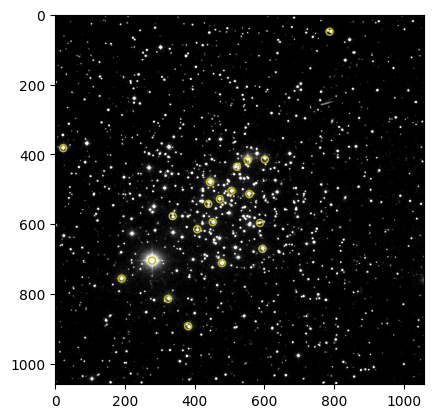
Plate solving#
We can now plate solve using twirl.
We first compute the center RA-DEC of the image and its field-of-view (usually known for a given telescope but taken here from the original wcs)
from astropy.wcs.utils import proj_plane_pixel_scales

fov = (data.shape * proj_plane_pixel_scales(true_wcs))[0]
center = true_wcs.pixel_to_world(*np.array(data.shape) / 2)
We query the Gaia stars RA-DEC in this field (a bit larger to have more stars)
from twirl import gaia_radecs
from twirl.geometry import sparsify

all_radecs = gaia_radecs(center, 1.2 * fov)

# we only keep stars 0.01 degree apart from each other
all_radecs = sparsify(all_radecs, 0.01)
And we compute the wcs based on the detected stars against the queried Gaia stars
from twirl import compute_wcs

# we only keep the 12 brightest stars from gaia
wcs = compute_wcs(xy, all_radecs[0:30], tolerance=10)
We can now over-plot the gaia stars based on their RA-DEC using the inferred WCS
# plotting to check the WCS
radecs_xy = np.array(wcs.world_to_pixel_values(all_radecs))
plt.imshow(data, vmin=np.median(data), vmax=3 * np.median(data), cmap="Greys_r")
_ = CircularAperture(radecs_xy, 5).plot(color="y", alpha=0.5)
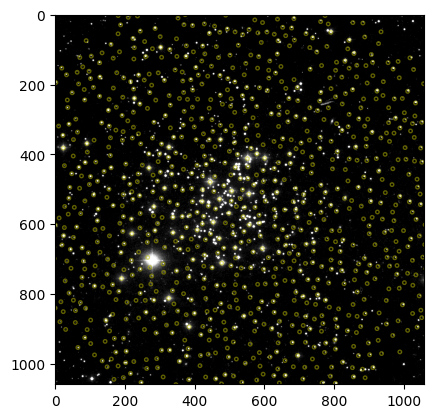
This validates our WCS solution